Choosing the Right Barricade Rental for Your Event: A Practical Guide for Planners and Venues
Crowd control equipment is one of the few line items in event planning where the consequences of getting it wrong extend well beyond budget. Insufficient or poorly chosen barricades contribute to overcrowding, unauthorized access, traffic incidents, and in the most serious cases, the kind of crowd-related safety failures that draw regulatory and media scrutiny. Selecting the right barricade rental configuration for an event requires understanding the available equipment categories, the operational demands of the venue, and the specific crowd dynamics anticipated during the event itself. For event planners, venue operators, municipal agencies, and security and logistics companies, building this understanding before equipment is ordered is the foundation of an event that runs as intended.
Understanding the Major Barricade Categories
The barricade rental market is generally divided into several distinct equipment categories, each suited to different applications. Bike rack barricades, also called pedestrian barricades or police barricades, are the most common form. Constructed of welded steel with interlocking ends, they create continuous lines suitable for queue management, parade routes, and general crowd separation. They are lightweight relative to other steel options, stack efficiently for transport, and connect quickly without tools.
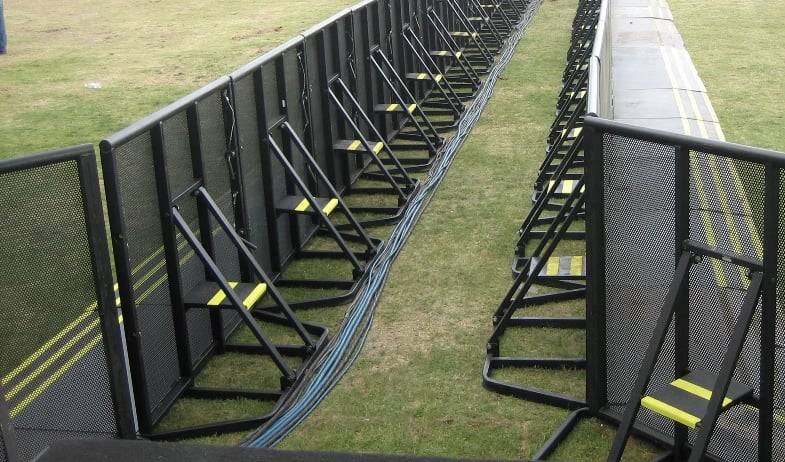
Steel crowd control barriers, sometimes called Mojo or French barriers, are heavier, taller, and engineered for higher-pressure crowd loads. Their increased weight and height make them appropriate for festival main stages, demonstration management, and any context where crowd surges are anticipated. They are the standard at major concerts, sporting events, and large public gatherings.
Plastic water-fillable barriers, often referred to as Jersey-style plastic barriers, serve traffic control, vehicle redirection, and perimeter establishment in contexts where steel is impractical. They are filled with water on site to provide weight, transported empty, and offer high visibility through brightly colored construction.
Pedestrian gates, expandable barriers, retractable belt stanchions, and post-and-rope systems serve more specialized indoor and queueing applications, including ticketing lines, VIP entry management, and venue circulation.
Matching Equipment to Event Type
The right barricade choice begins with understanding the event. Outdoor festivals with large general-admission crowds typically require a combination of heavy steel barriers at front-of-stage zones, bike rack barricades for queue management and secondary perimeters, and plastic water-fillable units for vehicle access points. Parades and street festivals lean heavily on bike rack barricades along route lines, with strategic gaps for emergency access. Sporting events and stadium operations often combine bike rack and steel barriers for tailgating zones, ingress and egress management, and post-event dispersal.
Public works and construction projects typically rely on plastic barriers for traffic redirection and pedestrian protection. Municipal events, including parades, public meetings, and demonstrations, mix barricade types based on the specific risk profile and crowd size anticipated.
Quantity and Configuration Planning
Underestimating quantity is one of the most common mistakes in barricade rental procurement. The general planning approach is to map the perimeter and internal circulation lines on a venue diagram, calculate linear footage by category, and add a contingency margin of fifteen to twenty percent for unexpected requirements that emerge during setup. Continuous barrier lines should be specified in linear feet rather than unit counts, since unit dimensions vary by manufacturer and category.
Configuration planning includes identifying entry and exit gates, emergency access points, accessible pathways, and zones where barrier types need to transition between categories. A clear site plan developed in advance reduces the on-site adjustments that consume crew time and create gaps in coverage during high-pressure setup windows.
Logistics and Delivery Considerations
Barricade rental is a logistics-intensive procurement category. Equipment must be delivered, staged, deployed, recovered, and returned within tight event timelines, often working around venue access restrictions, union labor rules, and parallel vendor activity. Reputable suppliers provide delivery scheduling, on-site placement support, and pickup coordination as part of the rental, and they communicate clearly about access requirements, equipment counts, and contingency planning.
For multi-day events, mid-event reconfiguration capacity, replacement of damaged units, and continuity of supply during peak periods are operational variables that distinguish a workable supplier relationship from a problematic one.
Compliance and Insurance
Barricades are safety equipment, and the supplier should provide documentation of equipment condition, load ratings where applicable, and insurance coverage appropriate to the rental scale. Municipalities, federal agencies, and large venue operators often require specific certifications, bonding, or compliance documentation that should be confirmed during the procurement process rather than at delivery.
A well-planned barricade deployment is invisible to attendees and indispensable to operators. The right equipment, in the right quantities, configured against a clear site plan and supported by reliable logistics, allows the event itself to take center stage. For event planners, venue operators, municipal agencies, and security partners building the operational foundation for events that need to run cleanly from setup through teardown, Epic Crowd Control provides crowd control rental equipment, planning support, and logistics coordination engineered around the realities of how live events actually unfold.